The circular economy business opportunity
Depending on your business, circular innovation opportunities may present across:
- Business processes – improving internal systems and supply chain practices to improve efficiency and design out waste. See the list of business practices you can explore here.
- Products and services – innovate through circular design and service offerings to prevent waste across the supply chain and improve the lifespan of products. Read about examples of circular products and services.
- Business models – alternative models such as digitalisation, demand driven production or product as a service. Have a look at thispractical guide to circular business model design. For a deeper dive into the theory of circular business models, read this report.
Opportunity for innovation across a product lifecycle
One way to explore business opportunities in the circular economy is to look at a product through the lens of its lifecycle. A product's lifecycle can be broken down into the pre-use, use, and post-use phase.
The below diagram aims to visualise a product lifecycle to showcase the opportunity for circularity at each stage. It combines 3 circular frameworks including:
- Narrow, Slow, Close the loop: a framework that can be used to demonstrate the overarching goals throughout a products lifecycle
- The Value Hill: relates to value of a product across it’s lifecycle
- The R-ladder: a framework that demonstrates a heirachy of circular actions across a product’s lifecyle.
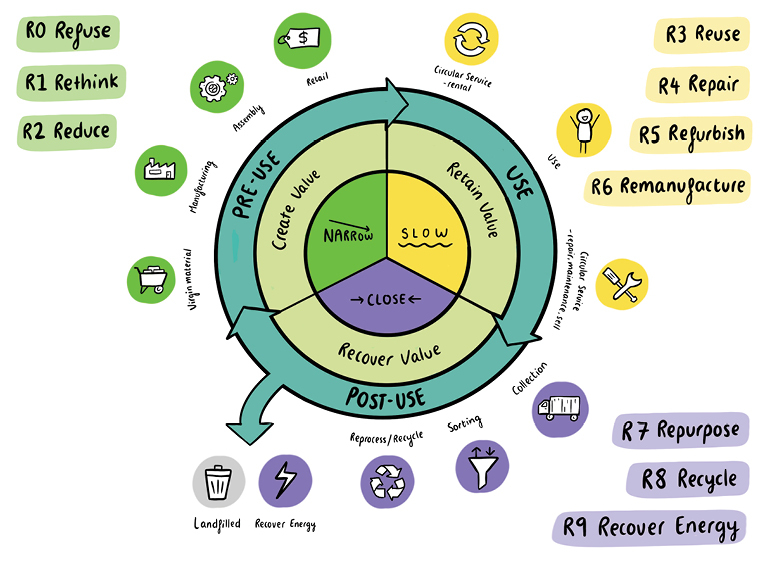 Figure 1: Circular Economy opportunities diagram: Adapted version of the Value Hill framework, developed by Sustainable Finance Lab, Circle Economy, Nuovalente, TUDelft, and het Groene Brein, The R-ladder developed by the Netherlands Environmental Assessment Agency. The slow, narrow, close framework developed by Nancy Bocken, Karen Miller, and Steve Evans.
 Pre-use phase
The pre-use phase of a product’s lifecycle has the highest potential for innovation and impact, where design can ensure a product has a circular trajectory.
In this phase, value is added to products through activities across manufacturing, assembly, and retail. The goal for circularity at this stage is to narrow the loop. This means using fewer resources, creating less waste and using smarter designs to prevent waste later in a product's lifecycle.
The R-ladder strategies that are most relevant here include:
R0 Refuse – Take away the function of the product to make it redundant or find a way to offer the same function but through a different product. For example, digitalisation as opposed to a physical product.
R1 Rethink – Focusing on design to improve circular outcomes. This may mean rethinking the need for single-use items, designing products for durability and longevity, considering sharing models, and exploring alternative materials that can enhance circularity further down the supply chain..
R2 Reduce – Use less natural resources and materials or find a way to make the product manufacture more efficient.
Use phase
The use-phase of a product’s lifecycle refers to the stage where a customer uses the product. This is where a product is at its highest value, and we want to use strategies to retain this value for as long as possible. The goal for circularity at this stage is to slow the loop. This may look like circular services such as rental or repair and refurbishing, activities that increase the length of time a product can be utilised for.
The R-ladder strategies that are most relevant here include:
R3 Reuse – increase the utilisation of products by creating systems that allow other consumers to reuse the product again and again.
R4 Repair – Repair and maintain the product to further extend it's usable life.
R5 Refurbish – restore or replace redundant parts, like reupholstering furniture or updating software
R6 Remanufacture - Use parts of old or discarded products to create a new versions of the product. Designing for modularity and dissasembly in the pre-use phase is the best way to achieve this strategy.
Post-use phase
The post-use phase is where the product's value starts to decline. This is the last opportunity to recover some form of value. The aim here is to close the loop, as slowly as possible. This means first attempting to recover value by repurposing materials at options that offer equal or higher value as the original product (e.g. a plastic bottle turned back into plastic a bottle) before lower-value applications are explored (like plastic bottles into a road base). This is only possible if considerations have been made at the design phase, which is why the pre-use phase has the highest potential to embed circularity throughout the system.
The R-ladder strategies that are most relevant here include:
R7 Repurpose – Make an entirely different product from discarded products or parts.
R8 Recycle – Breakdown and process materials to extract value to be recycled into another product.
R9 Recover energy – Incinerate the material to recover the energy from it. This is the last chance to recover any form of value.
Once a product is landfilled, there is minimal chance of recovering any value.